
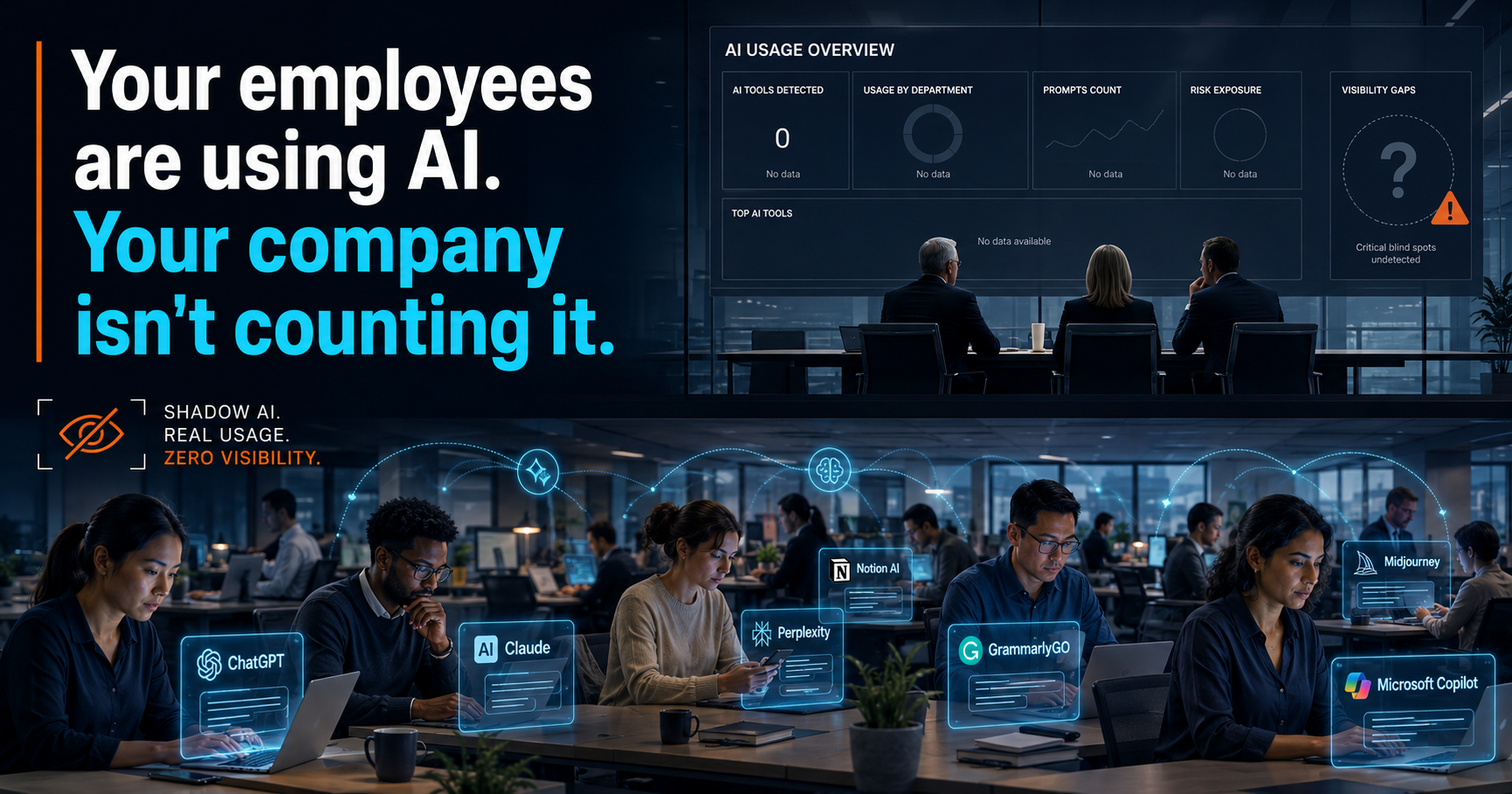
Picture an operations manager at a 60-person logistics company working through a government survey. One question asks whether the business used artificial intelligence in any business function. Nobody bought a license. Nobody deployed a model. No project ever went to the board. They tick no, and they are not lying.
Two desks over, a dispatcher is pasting customer addresses into a chatbot to clean up a route list. Accounting runs vendor invoices through a free summarizer because the PDFs are ugly and the summarizer is free. The best salesperson on the team has been drafting proposals with an assistant since last spring and has never mentioned it to anyone, because nobody asked and it feels a little like admitting the proposals were hard.
Both of those are true at the same company on the same day. That survey is real, and this year it started asking about both.
The survey
The Business Trends and Outlook Survey is run by the US Census Bureau. It samples about 1.2 million businesses, split into six panels of roughly 200,000, with data collection every two weeks and each panel reporting once every twelve weeks. Results are published biweekly and are representative of all employer businesses in the US economy, excluding farms. The Census Bureau sells nothing in this market, and it publishes its methodology.
In April 2026 a team of Census economists working with the University of Maryland published the analysis of the second AI supplement, covering November 2025 through January 2026. What makes it worth reading is that it measures AI use at three levels inside the same firm: whether the company uses AI in a business function, which functions those are, and whether workers use AI in their actual tasks. Firm surveys and worker surveys have existed separately for years. Asking both of the same company at the same time is the new part.
How much AI is running
18% of firms reported using AI in a business function. Weighted by employment, meaning each firm counted in proportion to its headcount, it is 32%. Firms expect that to reach 22% within six months.
The 18% is low partly because of what it counts. Every corner store weighs the same as every bank, and the country has far more corner stores. It is also a narrow window: the firm-level question asks about the prior two weeks, so a company that used AI in October and not in December answers no.
Concentration matters more than the headline. In information, professional services, and finance, use runs 50% to 60% among very large firms, and 60% to 70% employment-weighted. The Census authors expect those sectors to approach or pass 50% employment-weighted within six months, which means a majority of workers in knowledge industries will shortly be employed somewhere that uses AI.
Where it runs inside a company is narrow. Among firms using AI at all, 57% have it in three or fewer business functions. Sales and marketing leads at 52%, followed by strategy and business development at 45% and IT at 41%.
The layer underneath
Now the part that makes this survey different. Workers use AI in work-related tasks at 23% of firms, representing 41% of employment. That is higher than the 18% of firms that report using AI institutionally, and the overlap between the two is where it gets interesting.
14.4% of firms have both formal adoption and worker-task use. 6.8% have workers using AI with no reported firm-level adoption at all. Only 2.5% have formal adoption with no worker-task use. Put differently: in 36% of firms where workers use AI, the company reports no formal adoption. Among all firms with any AI presence, 61% have it at both levels, 29% have it only through workers, and 10% only institutionally.
The Census authors call this a bottom-up or grassroots trajectory, and they treat it as one of two real diffusion channels rather than an anomaly. Their phrasing is careful and worth keeping: worker task use sometimes occurs without formal firm-level adoption, and firm-level adoption sometimes occurs without worker task use. Counting both layers instead of one puts total AI incidence near 24% rather than 18%.
What it looks like in the work
Among firms reporting task-level use, writing and editing is the dominant application at 85% of firms, or 92% employment-weighted. Information search is a distant second at 50%, with document analysis and information processing behind it. Around 65% of use is confined to three or fewer tasks.
So the shape of this is not a company rebuilding itself around AI. It is people drafting things, looking things up, and getting through documents. The Census data on effects agrees: 44% of AI-using firms report augmenting worker tasks, 66% of firms seeing any task effect see augmentation alone, and only about 7% report both augmenting and substituting. AI-related employment decreases show up in 2% of firms.
Where the worker-side numbers come from
Two cautions on comparing across surveys, both of which the Census authors raise themselves.
First, the 23% is a share of firms, not of people. It means 23% of companies have workers using AI in tasks. It does not mean 23% of workers use AI. The authors state this directly, because it is the easiest number in the paper to misread.
Second, the reference periods differ. Firm-level use is measured over two weeks, worker-task use over six months, so some of the gap between 18% and 23% is calendar rather than behavior.
For an actual worker-population figure you need a worker survey. The Census paper cites Bick et al., whose Real-Time Population Survey found in its January to February 2026 wave that 43% of workers used generative AI for work. That is a different instrument with a different sampling frame asking a different question, and the Census authors are explicit that the two are not directly comparable. What survives the caveats is the direction: worker-facing measures consistently find more AI than firm-facing measures do, in the same economy, at the same time.
What it means
The volume is the story. Roughly a fifth of American businesses and a third of American employment sits inside firms that say they use AI, headed to more within the year, and concentrated hard in the sectors where most software gets written and most customer data lives.
Underneath that, a channel the org chart does not capture. Nearly three in ten companies with any AI presence have it purely because individual people started using it, and the work it is doing there is writing, searching, and reading documents. That is the plainest description of how this technology is entering most companies, and it comes from a survey of 1.2 million businesses run by an agency with nothing to sell.
What the survey does not tell you is whether any of it was approved. The Census Bureau counts use, not sanction, and there is no question on the form about who reviewed what. What it settles is the prior question, which is how much of this is actually happening. That number is no longer a guess.